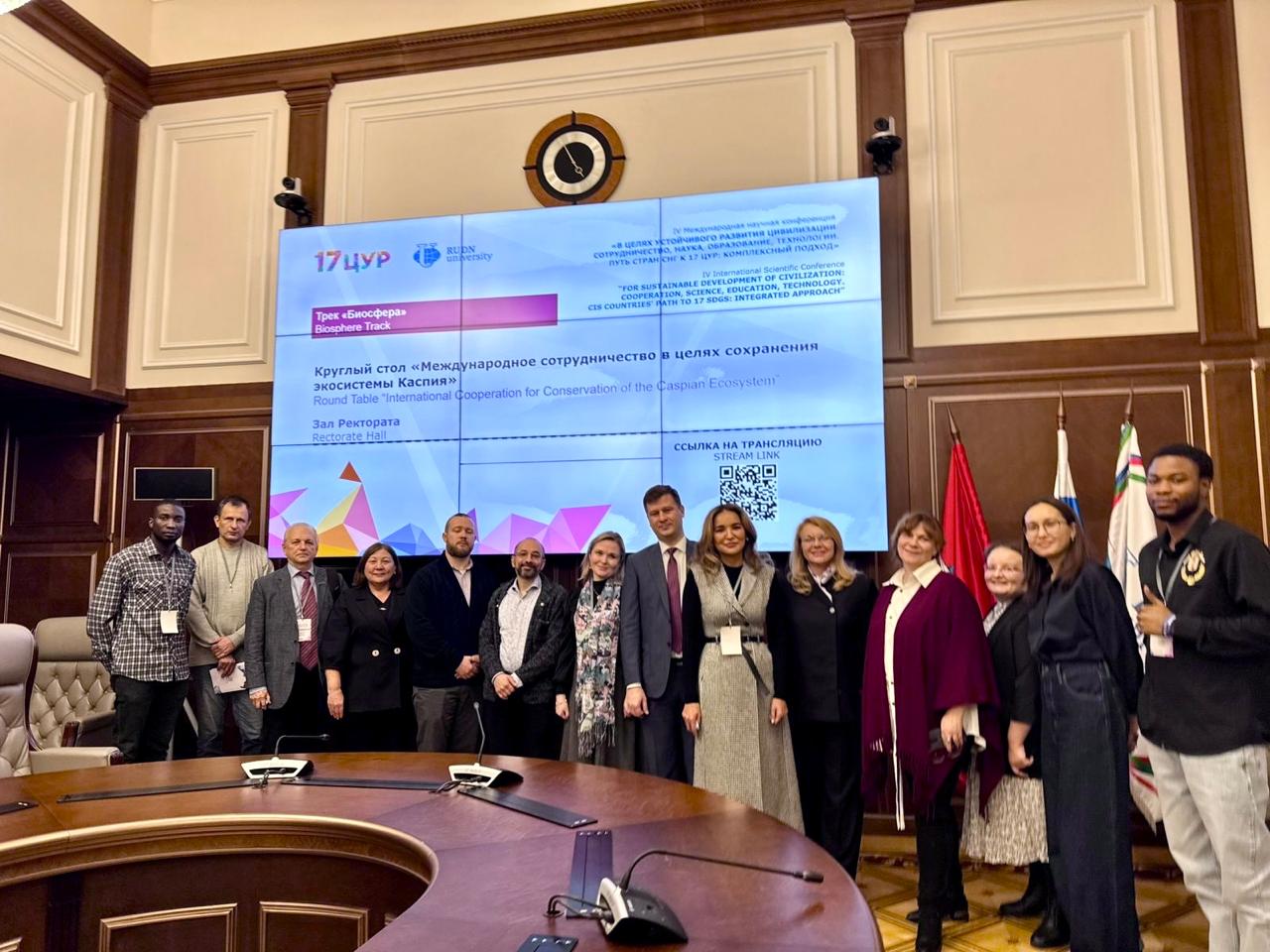
On 19 November 2025, the International Cooperation for Conservation of the Caspian Ecosystem panel discussion was hosted by the Patrice Lumumba Peoples' Friendship University of Russia (RUDN University) in Moscow. The event brought together representatives of research centres, government institutions, and environmental organisations from five Caspian coastal states: Azerbaijan, Iran, Kazakhstan, Russia, and Turkmenistan.
Aselle Tasmagambetova, an environmentalist and founder of the Central Asian Institute of Environmental Research (CAIER), was one of the key speakers at the session. Her report stressed the need for international environmental expertise and strengthened joint efforts by the states of the region to prevent biodiversity loss and the rapid shallowing of the Caspian Sea.
According to Aselle Tasmagambetova, CAIER has been working to address the deterioration of the environmental situation in the Caspian Sea since 2015. During this time, ten international expeditions have been conducted in cooperation with key scientists in the area of marine biodiversity.
CAIER collaborates with global institutions and scientists from around the world. Thus, a joint development project with KAUST University on lightweight electronic sensors for real-time tracking of seal routes and behaviour provides for operation in the extreme conditions of the Caspian Sea.
A project on seal isotope ecology conducted in the partnership with the University of California explores the feeding and migration patterns of the species.
The Seal Reference Genome project is a collaborative effort of CAIER together with the University of Arizona and Kozybayev University to create a genetic atlas of the species.
An interactive online platform is under development in liaison with Yandex Cloud as a technology partner. The platform shall combine satellite data, field research and environmental monitoring data into a single digital system. The platform is expected to be available for public use by mid-2026.
In addition, in the panel discussion, participants focused on recent research data: over the past 30 years, the Caspian Sea level has dropped by 2.3 meters, and the shallowing is increasing at a rapid pace. The reduction of wetlands, loss of bird migration habitats, and the increased vulnerability raised vulnerability of the Caspian seal, and other adverse consequences require urgent joint action.
The panel discussion became an important platform for strengthening cooperation between the countries in the region and considering practical steps to preserve the largest inland water body on the Earth.
Today, the Caspian states develop new mechanisms for cooperation. Regular meetings at the ministerial level, annual intergovernmental meetings, and, in the future, the establishment of the Caspian Economic Cooperation Organisation and a Parliamentary Assembly are on agenda.
The partners have put forward a number of significant initiatives: Russia proposed to create a flexible five-party forum – the Caspian Council; Kazakhstan put forward an initiative to establish a Caspian food hub; and Turkmenistan proposed to establish a Business Cooperation Council. Projects for the establishment of joint economic institutions are also under consideration.
Aselle Tasmagambetova, an environmentalist and founder of the Central Asian Institute of Environmental Research (CAIER), was one of the key speakers at the session. Her report stressed the need for international environmental expertise and strengthened joint efforts by the states of the region to prevent biodiversity loss and the rapid shallowing of the Caspian Sea.
According to Aselle Tasmagambetova, CAIER has been working to address the deterioration of the environmental situation in the Caspian Sea since 2015. During this time, ten international expeditions have been conducted in cooperation with key scientists in the area of marine biodiversity.
CAIER collaborates with global institutions and scientists from around the world. Thus, a joint development project with KAUST University on lightweight electronic sensors for real-time tracking of seal routes and behaviour provides for operation in the extreme conditions of the Caspian Sea.
A project on seal isotope ecology conducted in the partnership with the University of California explores the feeding and migration patterns of the species.
The Seal Reference Genome project is a collaborative effort of CAIER together with the University of Arizona and Kozybayev University to create a genetic atlas of the species.
An interactive online platform is under development in liaison with Yandex Cloud as a technology partner. The platform shall combine satellite data, field research and environmental monitoring data into a single digital system. The platform is expected to be available for public use by mid-2026.
In addition, in the panel discussion, participants focused on recent research data: over the past 30 years, the Caspian Sea level has dropped by 2.3 meters, and the shallowing is increasing at a rapid pace. The reduction of wetlands, loss of bird migration habitats, and the increased vulnerability raised vulnerability of the Caspian seal, and other adverse consequences require urgent joint action.
The panel discussion became an important platform for strengthening cooperation between the countries in the region and considering practical steps to preserve the largest inland water body on the Earth.
Today, the Caspian states develop new mechanisms for cooperation. Regular meetings at the ministerial level, annual intergovernmental meetings, and, in the future, the establishment of the Caspian Economic Cooperation Organisation and a Parliamentary Assembly are on agenda.
The partners have put forward a number of significant initiatives: Russia proposed to create a flexible five-party forum – the Caspian Council; Kazakhstan put forward an initiative to establish a Caspian food hub; and Turkmenistan proposed to establish a Business Cooperation Council. Projects for the establishment of joint economic institutions are also under consideration.